Showing posts with label animals. Show all posts

Thursday, August 22, 2019

FEATURED AUTHOR: ROBIN LAMONT


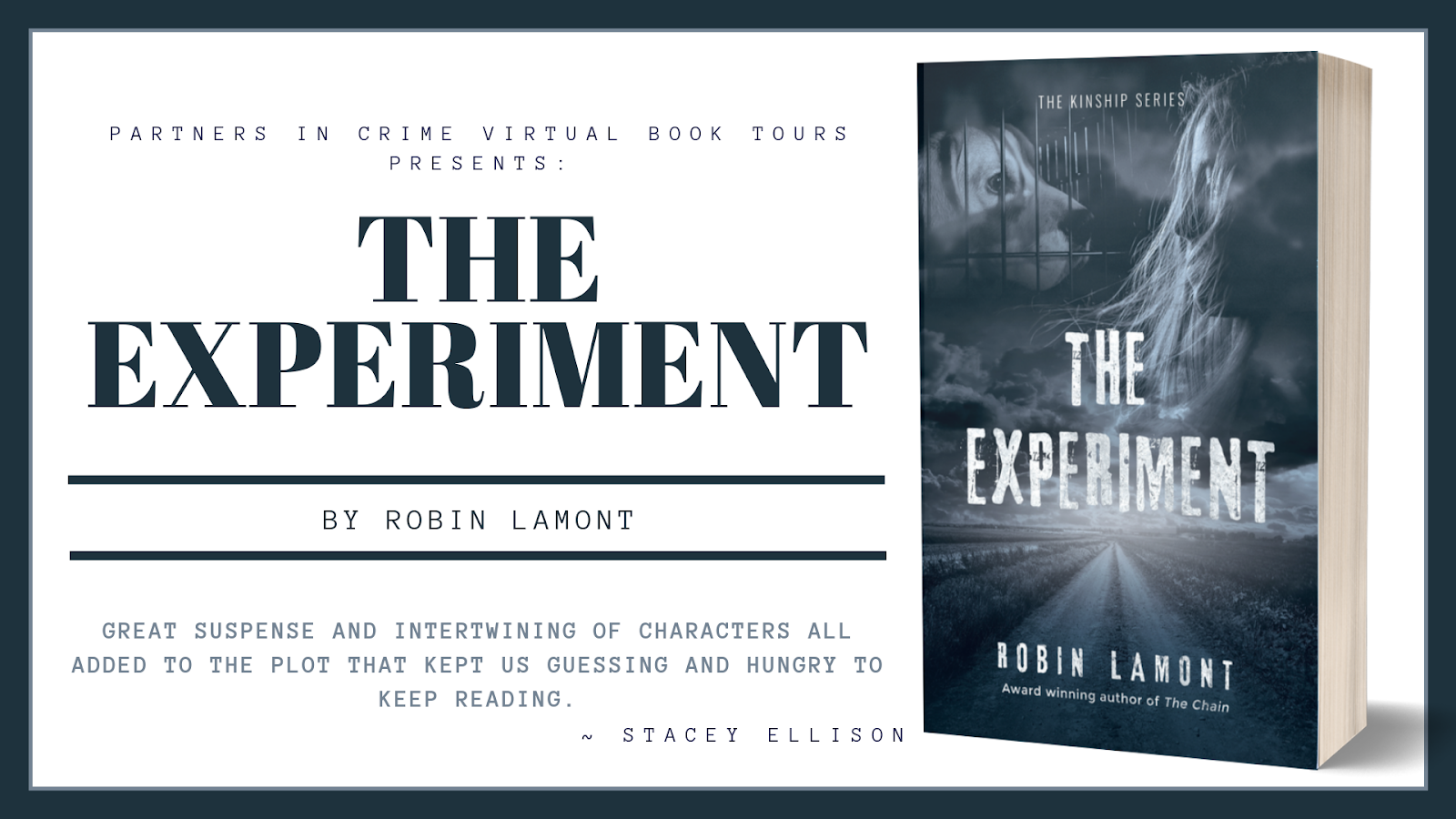
ABOUT THE BOOK


A rookie investigator working undercover for an animal protection group suddenly vanishes. But when his handler Jude Brannock goes searching for him, she discovers that he might not be who she thought he was. Determined to find the truth, Jude unearths a drug company’s deadly secret and is forced to confront some dark secrets of her own.


Book Details:


Title: The Experiment


Author: Robin Lamont


Genre: Suspense


Series: The Kinship Series, book 3


Publisher: Grayling Press
 (May 16, 2019)

Print length: 288 pages

On tour with: Partners In Crime Book Tours


LOVE IT OR LEAVE IT WITH ROBIN LAMONT


Things you need in order to write: a clear idea of where the scene is going.
Things that hamper your writing: becoming too focused on details (like tiny pieces o dialogue) and losing sight of what’s at stake.


Easiest thing about being a writer: falling in love with my characters.

Hardest thing about being a writer: forming the overall arc of a book.


Things you love about where you live: walks in the park with my dog; the birds in the morning; being able to grow apple trees in the yard.
Things that make you want to move: the trip into New York City; not having take-out restaurants nearby; snow.

Things you never want to run out of: coffee; soy sauce; ideas
Things you wish you’d never bought: the last 3 items I bought online from China; an electronic food mixer; a can of stuffed grape leaves (in the cabinet now for 3 years). 


Favorite beverage: a nice glass of Chardonnay.

Something that gives you a pickle face: tomato juice.

Something you’re really good at: taking naps.

Something you’re really bad at: making doctor’s appointments.


Something you wish you could do: play the banjo.
Something you wish you’d never learned to do: nothing comes to mind.

People you consider as heroes: people who save wild animals from poachers (actually, anyone who tries to save animals from being hurt).

People with a big L on their foreheads: The big L belongs on those who remain quiet in the face of cruelty and intolerance.


Last best thing you ate: a chocolate hazelnut cookie from Trader Joe’s.

Last thing you regret eating: some pineapple that had gone bad.

Things you always put in your books: human drama.

Things you never put in your books: gratuitous violence.

Things to say to an author: “Congratulations on getting that book/article/blog post out.”

Things to say to an author if you want to be fictionally killed off in their next book: “Where do you get your ideas?”

Favorite places you’ve been: Sicily; Edinburgh; London
.
Places you never want to go to again: an emergency room, Las Vegas, Chicago in the dead of winter.

Favorite books: dark, psychological suspense, Scottish fiction.

Books you would ban: paleo cookbooks, books that really ought to be just magazine articles.

People you’d like to invite to dinner (living): Martina Navratilova; Megan Rapinoe; Ricky Gervais. 
People you’d cancel dinner on: they shall go nameless.

Favorite things to do: play tennis; watch tennis; play tennis with my kids, play tennis with my husband, did I say, “play tennis?”
Things you’d run through a fire wearing gasoline pants to get out of doing: vacuum; wash floors; dust.


EXCERPT FROM THE EXPERIMENT


John Harbolt wasn’t easily shaken. With over forty years of medicine under his belt, there was hardly an injury, disease, or fatality he hadn’t seen, and he’d treated just about everyone in the small town of Half Moon at some time or other. But on that late summer day, young Tori Lacey showed him something that baffled him. Her symptoms were inexplicable and downright scary.
She was his first patient of the day, a young woman who had battled her weight for years. In between the earaches and the sore throats, Harbolt had gently counseled her about diet and exercise. He hoped she wasn’t here to ask him about diet pills again, because as far as he was concerned, they were off the table.
After removing her file from the plastic holder bolted to the outside of the examination room, he adjusted his wire rim glasses and straightened his lab coat. The younger doctors often wore khakis and a short-sleeved shirt at work, and maybe it put the kids more at ease. But Dr. Harbolt stuck with a freshly starched white coat, believing that it made his patients feel more confident in his abilities. And confidence in one’s doctor was important to the healing process.
“Tori Ann Lacey,” he announced jovially as he shambled into the room.
“Hi, Dr. Harbolt.” The morose girl before him sat on the table. She had taken off her running shoes but left her sweatshirt and shorts on.
“I haven’t seen you for a while,” he said, noting with some surprise that she had slimmed considerably, her round face now leaner and more mature. “How is college life treating you?”
“Ok, I guess.” Her voice and posture belied this.
“What brings you here today, my dear.”
“I don’t really know. But we thought you should look at these.” She pushed back the sleeve of her sweatshirt and held out her arm for inspection.
There were several bruises that vandalized the translucent skin of her inner arm. Dr. Harbolt held her wrist and peering over his glasses, looked closely at the red and purple marks.
He pressed lightly on one of them. “Does that hurt?”
She shook her head no.
“What happened?”
“That’s the thing. Nothing happened. They just appeared.” She showed him another set of bruises on her other arm.
“Did you fall?”
“No.”
“Knocked into something?”
“No,” she exclaimed, as though he didn’t believe her. “My mom thinks it’s my diet. That I should be eating meat.”
“And you’re not?”
“No. I needed to lose five more pounds for the track team, which I was having a hard time doing, so I switched over to a raw food diet. And it really helped because I made my goal.”
“And you were selected for the team?”
She nodded, anxiously chewing on a nail.
“Congratulations. You getting enough protein?” he asked, studying the bruising and letting her answer drift past him. This wasn’t because of her diet.
She rambled for a moment about nuts and spinach, then peeled off her socks and lifted her bare feet to the end of the examination table. “And then yesterday after a run, I found this,” she said. “I didn’t even show my mom ’cause she’d freak out.”
Dr. Harbolt caught his breath. It looked as though someone had taken a baseball bat to the soles of the girl’s feet. Fiery maroon blotches screamed out some kind of violence. Three of her toes had turned a dark purple.
“Good Lord!” he blurted out. “What happened to you?”
“Nothing! I’m telling you nothing happened,” wailed Tori. “They just … showed up.”
***
Excerpt from The Experiment by Robin Lamont. Copyright © 2019 by Robin Lamont. Reproduced with permission from Robin Lamont. All rights reserved.


ABOUT THE AUTHOR  


Author Robin Lamont’s diverse careers include Broadway actress, private investigator, and criminal prosecutor. Her novel If Thy Right Hand was named a Best Book by Suspense Magazine and awarded the Gold Medal in the Independent Publishers Book Awards. Her book The Chain, the first in The Kinship Series, was a Foreword Reviews Book of the Year Finalist. She lives in Connecticut with her husband and beloved Golden Retriever, Kaley.


Connect with Robin:


Website  |  Blog  |  Facebook  |  Twitter  |  Goodreads

Buy the book:
Amazon Barnes & Noble

Friday, February 3, 2017

BOOK EXCERPT: CHRISTINE MEUNIER'S CONTAGIOUS


ABOUT THE BOOK

Not everything that can be caught by another person is a bad thing. As Jacqui, Geordie and Hannah learn about managing the health of their horses and avoiding contagious germs, they learn that their attitudes can be contagious, too.

When Captain and Jaq fall ill, Jacqui questions what else she can do instead of riding. The timing couldn’t be worse – she needs to practice for her upcoming dressage test.

Unexpectedly finding herself spending time with Jared, Jacqui is surprised when he declares he wants to learn to ride. And he wants her to teach him. Should she say yes?


BOOK EXCERPT FROM CONTAGIOUS—FREE REIN BOOK #6


Jacqui wasn’t sure whether to be surprised by the topic at kid’s church on Sunday or amused.  She was starting to realise that anything they discussed could be applied to something going on in her life.  She wasn’t sure if this was a coincidence, if it was God, or just to be expected.

“So today we’re going to talk about something that’s extremely contagious.  Do we all know what contagious means?” their teacher asked them.

Each of the children nodded their head.

“Great!  Give me some examples,” he said, wanting to make sure the word was understood.

“Chicken pox!” one said.

“A virus,” Jacqui called out.

“A cold,” another spoke up.

Brian nodded.

“All good answers.  All horrible things.  Can we think of something good that can be contagious?”
This was met by silence.  Brian looked around at each and every person sitting before him.  He grinned and turned his attention to Jacob.

“Jacob!  How are you today?” he asked in a gruff voice.

“Umm… good?” Jacob responded, unsure.

“And what about you, Jacqui?” Brian asked her softly.

“I’m well, thank you,” Jacqui replied just as softly.

“Geordie!  How has your week been?” Brian asked cheerfully.

“Great!” Geordie responded enthusiastically.

Brian laughed as the students watched him, confused.

“Did you think I was angry with you when I addressed you, Jacob?”

The young boy shrugged.

“I wasn’t sure why you were upset. I was questioning if it was something to do with me or something else.”

Brian nodded.

“Did everyone notice that the way I asked the question affected the way each person answered me?” he asked slowly.

As the children thought about this, they started to nod their heads.

“I think I would have answered you in my usual cheery tone,” Geordie argued, causing Brian to laugh.

“Wonderful!  And that brings me to a point I’d like us to discuss.  Firstly, I’d like to point out that our attitudes can be contagious.  It is up to us whether they are good or bad.”

He paused for a second to let everyone think about this.

“Geordie has already told us quite convincingly that she would be happy whether or not I spoke to her nicely,” Brian said with a grin, “and this is a good lesson for us to make note of.  People can be fickle.  We are happy with God as long as things are going well.  As soon as we hit a difficulty, then our attitude turns sour.  We think God is angry with us, or we get angry with Him!  We need to make sure our attitude is positive even when we’re going through negative things.  If we don’t, then we’re likely to affect people in a negative manner.”

Jacqui found herself thinking about Friday afternoon with Jared.  After he’d asked her to talk about horses she’d stopped talking.  He’d copied her and left her alone.  Although she was relieved by this, she wondered if it was her negative attitude toward him that had led him to not talking for the rest of the afternoon.

“You’re quiet,” Geordie observed as they headed out of kid’s church.

Jacqui shrugged.

“I was just thinking about what Brian said.  Because the horses have been sick, I’ve only thought about something contagious being a bad thing.  I didn’t really think that I could have a good attitude that other people could catch.”

Geordie grinned.

“Me neither!  But I like it.  I’m going to test it out.”

Jacqui looked at her friend in surprise, pausing.

“How?”

“By being really happy around people and seeing if it makes them respond in the same way!” she stated simply.

Jacqui thought about this and smiled.

“It sounds so simple when you put it that way.”

“Isn’t it?” Geordie asked, causing Jacqui to laugh.

“I guess it is that easy.  I’ll have to test your theory with Jared, then,” she said before thinking.
She put a hand to her mouth, wishing she hadn’t said anything.  Geordie looked at her friend in surprise, a smile making its way across her face slowly.

“There’s a story behind what you just said, I can tell!  What happened?”

Jacqui sighed.

“Because I can’t ride Jaq at the moment I was helping mum plant some trees after school on Friday.  You know how Jared helps mum in the garden on Fridays…” Jacqui prompted, earning a nod from Geordie.

“But I thought that was for the veggie garden?” her friend asked.

“Yeah, but when there isn’t anything to do in the veggie garden mum still sets Jared to work,” Jacqui explained, Geordie grinning at the statement.

“So you were both working with your mum?” Geordie guessed.

Jacqui nodded.

“And I think I was rude to Jared.  He said I didn’t talk much and then when I didn’t continue a conversation with him… well he ended up really quiet, too.”

Geordie thought about this as they headed towards Jacqui’s parents.

“Well if you think Jared’s quiet because of you, then it’s your turn to ask him a question.”

“Like what?” Jacqui asked as she looked for her parents.

“Like…  ‘Hey Jared, do you have a girlfriend?’” Geordie asked, causing Jacqui to look at her in surprise.

Geordie laughed as her friend turned red and looked around warily.  Jared had come along to church that morning with his two younger brothers.  Jacqui hadn’t seen him since they had gone to kid’s church.

“I was joking, Jacqui.  But… he is cute; I wouldn’t be surprised if he did,” Geordie caught her attention again.

Jacqui frowned at her friend.

“Well you’ve just proven your own theory wrong,” the young blonde said to her red headed friend.
“How?” Geordie asked curiously.

“Because you’re being positive while talking and it hasn’t had a positive effect on me,” she responded simply, walking over to her parents.

Geordie laughed and followed her friend.


ABOUT THE AUTHOR

Christine Meunier considers herself introduced to the wonderful world of horses at the late age of 13 when her parents agreed to lease a horse for her. She started experiencing horses via books from a young age and continues to do so, but recognises that horses cannot be learnt solely from books.
She has been studying horses from age 16, starting with the Certificate II in Horse Studies and she completed the Bachelor of Equine Science in 2016.


Christine has worked at numerous thoroughbred studs in Australia as well as overseas in Ireland for a breeding season.
She then gained experience in a couple of Melbourne based horse riding schools, instructing at a basic level before heading off overseas again, this time to South Africa to spend hours in the saddle of endurance and trail horses on the Wild Coast.


She writes a blog about equine education.


Connect with Christine:
Website  |  
Facebook  |   
Twitter   |    Goodreads  

2017 Interview with Christine

Buy the book:
Amazon

Monday, June 8, 2015

Featured Author: Nina Post


ABOUT THE BOOK

After returning to his hometown, a homicide detective investigates the brutal murder of his childhood friend, but as the evidence points to another face from his past, he must decode a cryptic series of clues to track down the killer.

INTERVIEW WITH NINA POST


Nina, tell us about your series. Is this book a standalone, or do readers
need to read the series in order?

The Shawn Danger Mysteries series is about homicide detective Shawn Danger, who
works in northwestern Pennsylvania. Shawn is patient, focused, very good at his job, and has an unusual approach to running the case. You don't need to read the books in order – they can be standalone.

Where’s home for you?
Washington state, home of the Sea-Tac Sloth.

If you had an extra $100 a week to spend on yourself, what would you buy?

Books, and books, and books.

What do you love about where you live?
Birds, trees, mountains, ferries, and the weather. Also, the Sea-Tac Sloth.

What makes you nervous?
Children.

What makes you happy?
Fruit festivals.

What makes you scared?
Most things.

What makes you excited?
The growing field of international cat tax law.

If you could only save one thing from your house, what would it be?

Assuming my husband is safe: my bowling ball collection, my anvil collection, and of course, my cast iron stove grate collection.

What brings you sheer delight?
Breakfast.

What’s one of your favorite quotes?
"She imagined that whenever she left the house, an all-points bulletin was sent to every freak in the city, who went screaming after her with single-minded purpose." -Middle Men, Jim Gavin

How did you create the plot for this book?
It came out of the protagonist's background. Then I outlined it. And then I did my Swedish plotting dance.

Who are your favorite authors?
A. A. Milne, E.B. White, L.M. Montgomery, W.B. Yeats.

What book are you currently reading and in what format?
Unlikely Allies: How a Merchant, a Playwright, and a Spy Saved the AmericanRevolution, by Joel Richard Paul – in hardcover.

What’s the best compliment you’ve ever received about your writing?

"Once someone reads one of your books, they're going to want to read all of your books."

That's petty darn great. What would your dream office look like?
The 'English Great Room of the Late Tudor Period, 1550-1603' from The Art Institute's Thorne Miniature Rooms.

What are you working on now?
I'm working on the sequel to my international thriller, The Zaanics Deceit. You can find out more about the first book at my website.

ABOUT THE AUTHOR

Nina Post is the author of seven novels, including Danger Returns in Pairs, Danger in Cat World, Extra Credit Epidemic, The Last Condo Board of the Apocalypse, The Last Donut Shop of the Apocalypse, One Ghost Per Serving, and The Zaanics Deceit. She lives in Seattle.

Connect with Nina:
Website  |  Twitter  |  Goodreads | Amazon


Wednesday, May 20, 2015

Guest Post by Carolyn Haines


About the book


Sarah Booth Delaney is heartbroken: her fiancé Graf Milieu has decided to move to Hollywood permanently, leaving their relationship in shambles. Sarah Booth has a perfect distraction, however, in the form of the Black and Orange Halloween ball her best friends are throwing in New Orleans. Sarah Booth plans to dance the night away to the swinging tunes of her old flame Scott Hampton's blues band. But just as the party gets going, Scott receives a mysterious message that threatens his life and the lives of his bandmates. Sarah Booth knows that a new case is just what she needs to take her mind off her failed relationship with Graf, and she's ready to help Scott investigate. And then the message turns from threat to reality when the bartender from Scott's club is gunned down in a drive-by. Enlisting Sheriff Coleman Peters and the rest of her friends from Zinnia, Mississippi, Sarah Booth is caught in a race against the clock as she tries to stop a killer from striking again.

With a twist around every corner, Carolyn Haines will delight readers with Sarah Booth Delaney's latest zany adventure in Bone to be Wild.


Form Versus Formula


    I teach fiction writing at a university, both graduate and undergraduate students. Part of my duties includes working with students on thesis projects. One thing about teaching — if I intend to answer the hard questions serious students ask, I have to learn and keep learning every week.

    After publishing 70 books, I’ve learned some lessons the hard way, and perhaps the students will benefit from my journey. The first thing I tell them is this: The two most important things a writer decides is whose story she’s writing and which POV the writer will use to tell the story. These are crucial. Most books can be only one person’s story. (There are exceptions to everything, so these are general rules.)

    So many young writers want to tell everyone’s story. It’s difficult to learn how to cut out that one story from the herd of great stories and focus on that. It is crucial, though.

    Point of view, whether first or third. (I’m not a huge fan of second person POV for a novel. Short stories, fine. Novels, very difficult.) This decision impacts the structure of your book. In my opinion, most failed novels either have structural flaws or the plot is faulty. The smartest thing to do is focus on the structure before you begin writing. This will save a whole lot of rewriting down the road. And perhaps keep more hair on your head than torn out on the floor!

    Here is where we get to the issue of form versus formula. Many young writers, especially in graduate programs, have disdain for what they consider to be formula fiction. Many genres fall into this student created dump. But what young writers fail to understand is that all artistic endeavors must follow form. Symphonies have movements. Paintings have a flow the eye naturally follows. Songs have verses and a chorus, and poetry has a dozen forms that test the ability of any writer.

    Fiction—or story, if you prefer—also has form. From the first drawings on cave walls, those wishing to impart a story or information had to create a pattern, or form, in which to convey their story. We in America read left to right, top to bottom. It’s the formula of the page. Story must have form or else it is incomprehensible. If a writer just threw scenes in random order into a book, the reader would be lost.

    But some types of books do have a more regimented form than others. Because they meet reader expectation in a particular way. In romance, for instance, happy endings are often part of the story. Readers expect this, and they get very upset if this is tampered with. But what’s wrong with meeting reader expectation? If a happy ending isn’t in the card for your characters, steer clear of the romance market and sell to an audience with different expectations.

    The three-act screenplay for movies has been taught for decades, and the most successful movies ever made bow to this form (or formula, if you insist). I seldom hear screenwriters debating the merits of ‘formula.’ They know to finance the cost of a film, they must meet the expectations of an audience. Only in fiction do I hear disdain for formula. And formula is only a box or prison if a writer doesn’t truly understand how it works.

    Readers love the rise and fall of action, the forward movement of the plot, the growth of the protagonist’s character. Whether it is general fiction, women’s fiction, thriller, mystery, or romance, story is what matters. It is how the writer executes her story that determines whether a book will gather an audience or not. Story trumps everything else.

    Whether you physically write an outline or merely think the story through, relying on character motivations (this should be what drives any story), you will save a lot of time if you study structure. After all, you wouldn’t build a house hurly-burly throwing up walls wherever. You need support for the roof and flow from room to room. Writing a book requires exactly the same thing.

    There’s plenty of freedom here. This isn’t a rigid box. The way you execute story is where you shine as a writer, but a nod to form and structure will make your story tighter and the journey of writing it a lot more pleasant.


About the author

Carolyn Haines has published over 70 books in a number of genres from general fiction to crime novel and cozy mystery. She was awarded the Harper Lee Award for Distinguished Writing and the Richard Wright Award for Literary Excellence. She lives on a farm with 22 dogs, cats, and horses and is the sole labor force for Good Fortune Farm Refuge, a 501c3 rescue. She teaches fiction writing at an Alabama university. You can learn more about Carolyn, her rescue, or her crazy life at www.carolynhaines.com. Or you can join her on Facebook, Instagram, and Twitter.

Thursday, December 4, 2014

Guest Post by Susan J. Kroupa


About the book:

Who knew chasing a rat in the middle of a Christmas pageant could cause so much trouble? Certainly not Doodle, the obedience-impaired labradoodle who works for “the boss,” Josh Hunter of Hunter Bed Bug Detection, nor Molly, the boss’s ten-year-old daughter. But then Doodle’s the first to admit he doesn’t quite get Christmas.

Doodle’s antics during the pageant draw the attention of a popular video-blogger, who asks to do a feature his on sniffer-dog skills. But when the blog airs, pretty much the opposite of what Molly and the boss expected, the boss’s phone rings off the hook with distraught customers who think Doodle’s bed bug “finds” can’t be trusted. Molly, searching for a way to set things right, befriends the blogger’s son, a boy alienated from his mother who wants only to go live with his father.

Throw in a handful of threatening letters, some lost dogs, and a devastating fire, and Molly and Doodle have their hands—well, in Doodle’s case, his paws—full finding out just who’s been naughty and who’s been nice.

A charming cozy for all seasons and for dog lovers of all ages.


Labra—whaaaat?

Okay, I’ll admit it. I didn’t invent Doodle, the wise-cracking, bed-bug-detecting narrator of the Doodlebugged mysteries, out of whole cloth—or, um fur. It happens that many of Doodle’s more eccentric traits came from observation of Shadow, a labradoodle we adopted as a filthy, flea-bitten puppy on a frigid November afternoon in 2008. For me, finding Shadow was the culmination of years of what I can only call labradoodle lust, which struck me when I first began reading about Australian labradoodles.

Developed by Wally Cochran (beginning in 1989) specifically to be non-shedding and mostly hypoallergenic service dogs, Australian labradoodles were crosses of Australian Labrador retrievers (generally calmer and smaller than American Labrador retrievers) and standard poodles. They were designed to be service dogs for people who are allergic to golden retrievers and German shepherds and other typical service breeds. The goal was to get a hypoallergenic coat on a dog who would be happy, if not thrilled, to be a service dog.
At this point, you might say, “Hey, poodles already have the hypoallergenic, non-shedding coat. Why go to all the trouble to create a new breed?”

You would think this only if you’ve never lived with a poodle.  Dog-behaviorist Stanley Coren, who ranks different breeds of dogs by order of intelligence in his aptly named book,  The Intelligence of Dogs, places poodles second from the top as far as intelligence. (Labrador retrievers aren’t slouches in the in the smarts department either—Coren rates them seventh.  Naturally, those over-achieving border collies come in first.)   But about the poodle personality, he says something to the effect that poodles are born thinking they’ve won the grand lottery of life.

Smart, yes. Clever, definitely. Self-esteem? Can we say entitled? In fact, poodles have so much self-esteem that they often don’t see the need to take advice or instruction from anyone else, particularly the humans in their lives.

Other adjectives frequently used in regard to poodles: reserved, aloof, independent. Not, as you can see, your basic service-dog personality. (Now, before you poodle lovers rush to your keyboards, let me say, first, that I know there are many exceptions and I’m sure your dog is one of them, and second, that I love poodles myself. Heck, I practically own—well, live with— one, but more on that later.)

Reserved, aloof and independent certainly describes Shadow. Later, I would learn that a term for dogs with these traits, used by Jane Killion in her excellent training manual, When Pigs Fly. The term is non-biddable.  Killion defines biddable as “having an inclination to both work with and take direction from man.” (Or, of course, woman.)  She goes on to say, “If you laughed when you read the definition of biddable you definitely do not have one of those dogs.” What can I say? I laughed.

So the Labrador part of the labradoodle equation was to make the breed more user-friendly. The Mac version rather than the PC. Or the PC version rather than the Linux, depending upon your software biases. That’s what Wally Cochran was looking for in 1989 when he began crossing the two breeds in search of a hypoallergenic service dog.

Calm, clever, biddable, and an added bonus thrown in for free: cute. Really cute. Okay, I got the clever and cute part in my labradoodle bundle. Calm? Let’s just say for the first two years of his life we called Shadow “the barkster.” Biddable? Excuse me while I wipe the tears of laughter from my eyes.

 As Doodle puts it, labradoodles are supposed to have, “All the warmth and bonding of a Labrador retriever combined with the intelligence and the hypoallergenic coat of a poodle.” Only in Doodle’s case—and not uncoincidentally in our own—it didn’t quite work out that way. In Bed-Bugged, the first book in the series, one of Doodle’s service dog trainers claims Doodle seems to have missed the Labrador part. “Too much doodle. Not enough labra,” is how he puts it.

That line, stolen from a neighbor’s observation about Shadow and shamelessly used in the book, pretty much says it all.

Of course, Shadow is not Doodle, in the same way that human fictional characters are generally composites rather than clones of real people. For one thing, Doodle has skills. Actual money-making skills. After flunking out of service-dog school for his above-mentioned attitude issues, he ends up having a “career-change” and gets trained as a bed bug dog. Adopted into a new family, Doodle helps the “boss,” Josh Hunter, find bed bugs and helps the boss’s ten-year-old daughter, Molly, solve mysteries.

Shadow, on the other hand, most likely can’t tell a bed bug from termite or cockroach, and most certainly doesn’t care. Of course, we love him anyway. His keen intelligence, his grand sense of humor, and his ever-amiable personality have made him a cherished member of our family. Admittedly, the first year of his life was a difficult one for all of us as we had to learn how to deal with a high-energy, high drive pup, and he had to learn he couldn’t be the emperor of the world. But now we’re one big happy family. Don’t you just love a happy ending?

For more happy endings and a chance to meet Doodle, check out the Doodlebugged mysteries on Susan's webpage or her Amazon author page.  

About the author:

Susan J. Kroupa is the award-winning author of the Doodlebugged mysteries, which have been called, “. . . the perfect blend of mystery, suspense, and laugh-out-loud doggy observations” by best-selling author Virginia Smith, and which feature Doodle, the irrepressible canine narrator of the series.
She is also a dog lover, currently owned by a 70 pound labradoodle whose superpower is bringing home dead possums and raccoons, and who just happens to be the inspiration for some of Doodle’s more obedience-challenged behavior.
She now lives in the beautiful Blue Ridge Mountains in Southwestern Virginia, where she’s busy taking photos and writing the next Doodlebugged mystery. You can see samples of both on her webpage, www.susankroupa.com.

Connect with Susan:
Webpage | BlogFacebookTwitter | GoodreadsAmazon Author Page