Showing posts with label Bob Rich. Show all posts

Wednesday, February 2, 2022

FEATURED AUTHOR: BOB RICH


ABOUT THE BOOK

From Depression to Contentment: A Self-Therapy Guide is a course of therapy in your pocket. You can be your own therapist, changing the way you see yourself and your world. Not only does this save lots of money, it also is 100% confidential. The book starts with first aid, provides an understanding of the nature and causes of suffering, instructs you in research-based techniques for dealing with your problems and, finally, teaches you an actual cure for depression.

•    Every tool in this book is based on research, but presented in an easy to understand, easy to apply manner.
•    With homework assignments, you will find your inner strengths, uncover the true source of happiness and develop great resilience.
•    Learn how to put the philosophies of all great religions to practical use, even if you are an atheist.
•    This program can help you start a new life - one of meaning, positivity and purpose.
•    Unlike instructional books, this book is not only useful but also enjoyable.

"If you're depressed and need someone who 'gets' you, who has been there and who can walk you through the journey toward a life worth living, then From Depression to Contentment will be your new best friend. Bob meets you where you are and can lead you home to yourself."
-- Petrea King, CEO and founder of Quest for Life Foundation

Book Details

Title: From Depression to Contentment: A self-therapy guide
Author: Bob Rich, Ph.D.
Genre: psychology self-help
Publisher: Loving Healing Press 2019
Print length: 155 pages


INTERVIEW WITH BOB RICH


How long have you been writing, and how did you start?

I became a writer because in 1980 a bunch of teenagers kidnapped me. They were playing a boys vs. girls soccer game, and needed one more male, so told me I had to help out. I was making mudbricks (adobe) at the time, and went with them, muddy boots and all.
Not surprisingly, I slipped and tore the cartilage in my knee. Let me tell you, that’s not a good idea.|
In hospital, I was bored out of my mind, so borrowed the office typewriter, (remember those?) and wrote a how-to article for Earth Garden magazine and became their owner-building expert, with a byline column for 40 years. This led to my first book, The Earth Garden Building Book: Design and build your own house. That went through 4 editions and sold hundreds of thousands of copies between 1986 and 2018.
|Later, I decided to train as a nurse, and this meant 5 nights a week in a nurses’ home where gorgeous 18-year-olds surrounded me. I had to choose between making a fool of myself or doing something creative, so I wrote short stories. The first I entered won a prize—and I was hooked. You can read this story here.

What inspired you to write this book?

I was born with the ability to heal with words. It is a karmic thing. Even in school, all the kids with problems cried on my shoulders. Trouble was, I had too much empathy, and often worried more about other people’s problems than they did.
Nursing toughened me up (the first lesson in nursing is: “It’s not your pain. You are not there to share it, but to relieve it.” In therapy, it’s even further: you are there to empower your client to relieve it.)
So, in the late 1980s I did an additional course, and I then had a psychotherapy practice until 2013.
It may shock and surprise you, but relieving suffering gives me great joy. I am odd that way. Since about 1999, I have been answering cries of desperation posted on various websites, and now people track me down thanks to many of my q&a posts in the public domain.
In fact, one of my earlier books is 50 such single-session email therapy exchanges .
I may have grown old, but I am still silly enough to be idealistic, and to make a difference. My book From Depression to Contentment: A self-therapy guide is a tool for transforming your life. I want it to work for as many people as I can.

How long did it take you to write this book?


Fiction is far more fun to write than nonfiction. I knew I needed a book to help with depression 15 years ago, and sort of started it, but it gathered dust inside my computer, with me occasionally adding to it. Then once I decided to, I whipped it into shape in 3 months, and sent it off to my publisher.
It was 95,000 words long, and he told me (well, emailed me) that people won’t read self-help books above 50,000 words. So, he forced me to amputate much of it. I managed this in two ways: in the book I set homework tasks (you change your life by DOING, not by KNOWING), much of which includes additional reading, and I used the excised parts as the start of a companion volume, Lifting the Gloom: Antidepressant writings.

What do you hope readers will get from this book?

It is a course of therapy in your pocket. If you faithfully and conscientiously do the program, you will grow spiritually (which is the purpose of life), gain immense inner strength and resilience, and survive anything, even Bob Rich’s humor.

How did you come up with the title of your book?

I am a fan of Carolyn Howard-Johnson and her how-to books on writing. I have edited most of them, which is a very frugal way of reading. Her advice on titles for a nonfiction book is to have it brief and pithy saying exactly what the book is about, then have a long subtitle that includes the keywords your target audience is likely to use in searches.

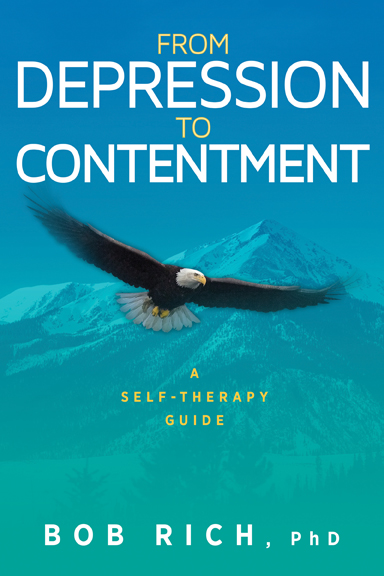
How did you come up with your cover art?

It’s actually designed by my publisher’s cover-art expert, but the concept is mine.
Birds are among my favorite people on this planet, and the wedgetail eagle is the favorite of favorites. You can read a guided imagery script about her here.
So, that’s what I wanted on the cover. But the only print-quality pic we could find was of a foreigner: an American bald eagle. (Actually, I am far more bald than they are.)

Do you have a routine for writing? Do you work better at night, in the afternoon, or in the morning?

I participate in a monthly round robin organized by a wonderful lady who teaches writing at a university, Rhobin Courtright. One of my essays is exactly on this topic.

Name one thing you couldn’t live without.

Oxygen.

Where do you call home?

I am a citizen of the Universe. All sentient beings are my family. Right now in this life I live on a tiny rock planet in orbit around a below-average yellow dwarf star in a fairly typical galaxy.
This planet is mostly water, and there are magnificent, intelligent aquatic creatures, but no, I am not one of them, but a land crawler. Most of the land on this mudball is currently in its northern hemisphere, though the blobs of land do move around. However, the best part is in the south, called Australia, which means Southern Land in some language.
There is a place called Melbourne, which has a population of about four and a half million land crawlers (as distinct from the cetacean owners of the planet). This is an outlying settlement of Healesville, which is 50 miles to its east. That gives me magnificent sunsets, thanks to the air pollution so many people cause.

What’s one of your favorite quotes?

Only one? That’s harsh. Being constitutionally unable to follow instructions, I give you a selection from the people I admire the most:
Dalai Lama: “My religion is kindness. The aim of enlightenment is to be of service.”
Mother Teresa: “Help one person at a time, and start with the one nearest to you.”
Greta Thunberg about the Glasgow climate talkfest: “Blah blah blah.”

For what would you like to be remembered?

Only two things matter in life: what you take with you when you die, and what you leave behind in the hearts of others. Everything else is Monopoly money.
What can you take with you: Lessons learnt, gained wisdom--or the opposite: hate, bitterness, blame and the like. So, you either advance in spiritual development, or go backward, or of course a bit of each. Look after the heart, the Love, and you can let go of everything else.

What scares you the most?

We are NOW in the 6th extinction event of Earth. When we have unraveled the web of life, we also fall though the hole. This is why I have been an environmental activist since 1972.

Are you an introvert or an extrovert?

Whatever organization I join, I soon become the convener of the Antisocial Committee, which refuses to meet, as a matter of principle.
For some lucky people, conversation is lubrication. Then there is my kind. For us, it is information. Tell me to have a chat with Amy and I’ll sit beside you like a dummy, unless you ask the right questions.
I am the genuine, patented party-pooper.
In answer to your question, I give you three guesses.

What is the most daring thing you've done?

Being born. In a past-life recall, I’ve learned that in this life, either I am doomed to witness the extinction of humanity, or be part of the team saving us. This is set out in my fictionalized autobiography, Sleeper, Awake.

What is the stupidest thing you've ever done?

See previous answer.

What are you working on now?

Much of my work is environmental, humanitarian and political activism. I am here to change the world, and am doing my best. So, I am very active in the political party The Australian Greens. Australia’s voting laws are different, and voting for a small party does not prevent you from still choosing among the two dinosaurs. One are conservatives, mis-labeled “Liberal,” the others are Labor, whose policies are Liberal Lite.
Part of this is a fundraising activity for the Greens candidate in my local electorate. I currently run weekly online sessions in positive psychology, training participants to use the tools within From Depression to Contentment and Lifting the Gloom.

Oh, you mean WRITING projects?
I am well into a book on grief, working title If You Have Lost a Loved One: How to cope with grief.
I have posted snippets on my blog already. Sadly, it is greatly needed.
Four short stories, and one partly finished, are ready for a new anthology, REAL Human Nature, focusing on all that’s good about people.
My publisher has a series of “101 tips about...” and wants me to write one on depression, so that’s on the way.
There is the start of a book focusing on positive psychology, Above Normal, and several unfinished short stories that don’t fit the specs of the anthology-in-waiting.
But my major project is a 5-volume science fiction series, "The Doom Healer.” I am currently pestering agents and publishers with the first volume. All I want to say about it here is that my hero, Bill Sutcliffe, will one day be beside Harry Potter.

Finally, from Bob:

I will make sure to answer any comments, and one week after publication date of this interview, will randomly select one commenter to receive a free electronic copy of a book. Again, you have three guesses regarding title.


ABOUT THE AUTHOR
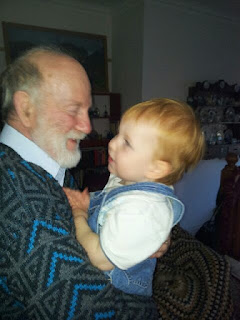
Bob Rich, Ph.D. earned his doctorate in psychology in 1972. He worked as an academic, researcher, and applied scientist until “retiring” the first time at 36 years of age. Later, he returned to psychology and qualified as a Counseling Psychologist, running a private practice for over 20 years. During this time, he was on the national executive of the College of Counselling Psychologists of the Australian Psychological Society (APS), then spent three years as a Director of the APS. He was the therapist referrers sent their most difficult cases to.

Bob retired in 2013, but still does pro bono counseling over the internet. This has given him hundreds of “children” and “grandchildren” he has never met, because many of these people stay in touch for years. His major joy in life is to be of benefit to others, which is why he wrote a book that’s in effect a course of therapy.

You can get to know him well at his blog, Bobbing Around.

Connect with Bob:
Website  |  Blog  |  Facebook  |  Twitter  |  Goodreads

Buy the book:
Amazon  |   Barnes & Noble  |  More


Thursday, June 1, 2017

FEATURED AUTHOR: DR. BOB RICH


ABOUT THE BOOK

1850, a small town in Australia: Glindi, an Aboriginal woman, gives birth to a daughter, the result of a rape by a white man. She names her Maraglindi, meaning "Glindi's sorrow," but the girl is a joy to all those around her. She has the gift of love.

During her short life, she encounters everything intolerant, cruel Victorian society can throw at people it considers to be animals. She surmounts the savagery of the white invader by conquering hate with love. Even beyond death, she spreads compassion, then she returns a second time, with an ending that will touch your heart.

Maraglindi: child of the land, fruit of an evil deed, and instrument of love.

This meticulously researched book of historical fiction is very relevant to our modern times, when hate and discrimination are becoming the norm once again.


WHAT THEY'RE SAYING:

“I loved the story, didn’t want to stop reading it.” -Writer of Australian historical fiction Margaret Tanner

“Dr. Bob Rich’s powerful work, while set in the past, is deeply relevant today, as we witness hatred and prejudice spread by persons in powerful places, through the power of modern media. We need you, Maraglindi! Come, Guardian Angel!” -Florence Weinberg, author of exciting, true-to period historical crime mysteries

Guardian Angel is a book I would not hesitate to recommend, not just as a story that describes the racial discord of earlier times, but also as one that holds out a hope that things can be different. We live in times where hate is rearing its ugly head once more, so we need stories like this to remind us that hate can be overcome, not by violence and more hatred, but by love and acceptance.” -Max Overton, award-winning writer in multiple genres including historical fiction


LOVE IT OR LEAVE IT INTERVIEW WITH BOB RICH


A few of your favorite things:
 
Grandchildren. I have a few in my family, and great-grandchildren too, but I also have hundreds of grandchildren I’ll never meet. This is because they send to me, or publicly post, cries for help like “I want to kill everyone in my school except for 2 people,” or “Why does everyone hate me?” or “Give me one reason I shouldn’t kill myself!” I get adult cries for help, too, but sadly, so many are from youngsters. I reply, and often my words make a difference, and we become email friends. You can see many q&a examples in my monthly newsletter Bobbing Around.
Things you need to throw out: 
Greed that’s wrecking our world; hate, discrimination, fear of the Other; all the cruelties and idiocies of our global culture. I want to replace this with a global culture that brings the best out in human nature: compassion, empathy, cooperation, decency.


Things you need in order to write:
 
1. My laptop computer, which seems to be grown to me. You see, I can’t read my own handwriting, and can type about as fast as I can speak, and nearly as fast as I can listen.
2. I also need being busy at many other things to give my inner creativity time to do my writing for me. You can read about how I cheat on being a writer here. Instead of doing it myself, I subcontract the job to Little Bob, who lives inside my head.
Things that hamper your writing: 
1. Being busy at many other things. They say you get busier when you retire. Well, I’ve retired 5 times from 5 different occupations, and the busyness multiplies rather than adds. 
2. Marketing. I actually know how to do it, but . . . as a teenager, I tried out being a salesman. I lasted one day, with no sales made. At the moment, more of my time than I like is consumed by telling the world about my just-published book, Guardian Angel because so far everyone who reviewed it has loved the story.
I have entered Guardian Angel in Amazon UK’s Storytelling contest. The first round is judged on sales, ratings, and reviews, so I’ve priced it at the minimum Amazon allows: 75 cents . . .  for now. So, I’d really appreciate a purchase, a quick read, and a review, especially at Amazon UK.

Things you love about writing:
1. This is like asking “things I love about breathing.” It keeps me alive. When I get stuck in my writing, or when the sticks and stones of the world get in the way so I don’t have the opportunity to write, I get grumpy and impossible to live with. Of course, when I am caught in a creative frenzy, I get grumpy and impossible to live with.
2. My characters. I invent them in the first place, but then they take charge. They come up with things I’d never dream of. For example, one 19-year-old fellow said to the supreme ruler of his people, “Life is too short for the seriousness it deserves.” I would never have thought of that! In my about-to-be-published story “Hit and Run” my 14-year-old multiple murderer is explaining to his little brother about deciding to do things differently: “Our way is, if there’s a wall in the way, we knock it down. But usually there’s a door, and it’s easier to walk through that, like.”
Things you hate about writing:

It means I need to have a computer because I can’t read my own writing. It requires me to be busy at many things to give my creativity a chance, and these get in the way of writing. It means I need to promote my books, and because now 16 are published, I really need to run in 16 different directions at once. I wish I was an artist so I could draw myself running in 16 different directions.

Things you love about where you live:
I share it with my ex-girlfriend. When I was a young fella I was very shy and depressed, a lost puppy looking for a home, and she took me in. We’ve just had our 50th wedding anniversary, and the silly woman still likes me and laughs at least at some of my jokes. For the rest, I do my best to practice Buddhist equanimity, which means that you can be content regardless of what’s around you. Muslims have the same concept with Insha’Allah. Acceptance of God’s will is also central to Christianity. So, I could be happy in a cave in the desert – as long as it had internet connection and room service (and my wife of course). But, in fact, I live in a beautiful part of the world, except that industrial civilization is doing its worst to wreck it with things like clearfell logging, and the cancerous growth of suburbs, and invasion by multinational corporations that starve local small businesses.
Things that make you want to move:
Absolutely nothing. As Pip, the narrator and hero of my novel, Ascending Spiral said, “As long as you take it with you, you can enjoy being miserable anywhere.” It’s the inside that counts, not where you put it.

Words that describe you:
1. People accuse me of being a square peg in a round hole. This is false: I am a fractal-shaped peg that makes its own hole. Sorry if you have to look up “fractal.” I’ve never been able to follow other people’s instructions or directions, but do things my way.
2. I am a citizen of the universe. As far as humans go, there is only one race: the human race. Every living being is precious to me, with the possible exception of mosquitoes.
Words that describe you but you wish they didn’t:
I am a human on planet earth. Next time around, I want to be in a very different kind of body. If you want to understand what I mean by this, you’ll need to read Ascending Spiral but here is a spoiler: there I describe two of my previous lives. In one, I was a space flower: a planet-sized, long-lived being whose pleasure is creating beauty. My most recent previous life has been as a walking, intelligent plant on an entirely different planet. Both of these have hugely superior bodies when compared to humans.

Something you’re really good at:
If someone else can do it, I can learn it. I got this insight at 21 years of age, and it was the start of my healing from severe trauma during infancy and childhood.

Something you’re really bad at:
Doing things right the first time. Part of that trauma was my stepfather’s opinion of me: “If there is a wrong way of doing it, or even if there isn’t, that boy will do it that way.” What made it worse was that he was correct. I still stuff up the first time at anything I try. But by the fifth time, I am good enough to teach other people how to do it. Several of my very successful books are “how to” instructions, including Woodworking for Idiots Like Me. All this is described in my award-winning biography, Anikó: The stranger who loved me.

Something you wish you could do:
I’d love to be able to play a musical instrument well, and to draw and paint. I’ve tried all of these, and got so far that I could play a few nice melodies on the piano, but such things are not easy for me. I draw with words.
Something you wish you’d never learned to do:
There ain’t no such animal. All knowledge is useful, even if you never use it. All skills are necessary even if you never practice them. Learning is growing, and inherently valuable. One result of this attitude is that I am good at trivial pursuit.

People you consider as heroes:
I am not a Catholic, or even a Christian, but I love Pope Francis. I am not a Hindu, but I love Gandhi, not an African but I love Mandela and Tutu. I am a different kind of Buddhist from the Dalai Lama, but I love him.
There are lots of others as well, of course. I have a category of “people who inspire” in my monthly newsletter, Bobbing Around.

People with a big L on their foreheads:
Trump, Putin, Assad, Filipino president Duterte, North Korea’s little boy Kim – all the leaders of hate, suppression, destruction are high on my list. I don’t hate them, but surely hate what they are doing.
Same for Muslim terrorists – and all those who discriminate against Muslims because of the actions of a tiny minority.
The self-described “Christians” who go against the words of Jesus and preach hate.
And if this is too political for you, it’s my opinion, not yours.


Things you’d walk a mile for:
I used to run more than a mile for no reason at all, as a form of meditation, and as an antidepressant. For years, I ran 100 miles a week, training 3 hours a day. When you burst through the pain barrier, you reach a space with no time, no thought, a zone of flow. Of course, there is a price to pay. I am now seriously considering a second hip replacement, though I am determined not to have a third one.
Things that make you want to run screaming from the room:
Opera. I hate shrieking and bellowing, which spoils the beautiful melodies. If they could only sing without all the artificial put-on vibratos and stuff, at a reasonable volume, something like folk singers or Joan Baez!

Things you always put in your books:
Writing.

Things you never put in your books:
In paper books, I never dogear a corner to mark the space, because my mother was a bookbinder by trade, and she trained me to look after books. But then, I do my best to read everything electronically, because in our crazy world they murder trees to make paper. Why not use annual plants like bamboo or hemp, and agricultural waste like straw?

Favorite books (or genre):
By the time I was 17, I’d read every book in the school library and the local public library. I haven’t stopped since. So, there are too many to mention. Dick Francis is probably my favorite author. I wish he was still alive to write a new book a year. I’ve read everything Isaac Asimov wrote, including his science textbooks and enjoy occasionally re-reading The Belgariad by David Eddings and the four books by Tolkien.
From time to time, I also enjoy re-reading the books I’ve written. This is dangerous, because I always want to make revisions.

Books you would ban:
Every piece of writing has hidden messages: the unvoiced, perhaps unthought, philosophy guiding the writer’s life. I refuse to read books the extol accumulating possessions; cruelty; putting down a person because of race, religion, sex or trivial physical characteristics like pimples or body shape or whatever. I expand on this here.

Things that make you happy:
Happiness is not a concept I value, because it is transient, and depends on things out of my control. Anything better than my current average is happy, what is worse is unhappy. So, instead, I aim for contentment. It is possible to be content in the worst hell, even while struggling to get out of it, or merely to stay alive.
I get contentment from daily meditation, from looking at the beauty of nature and the creations of the best in humanity. Watching young children gives me joy, and I love to play with them and make them laugh. I get a kick out of setting myself a goal and exceeding it (does happen sometimes). But the best is when I can do something that makes someone else’s life better, especially if I can keep it a secret. This is the Jewish concept of a Mitzvah.

Things that drive you crazy:
Well, nowadays that’s too strong a description, but making mistakes used to be a surefire trigger for depression, and as I’ve said, I’m really good at making mistakes whenever I try anything new. Nowadays, when I make a mistake, I exhibit a 5-second explosion, then laugh at myself. Then I think about how I should have done it, and if possible have another go.


ABOUT THE AUTHOR

Dr. Bob Rich is an Australian storyteller with 16.5 published books, 5 of them award-winners. Retired from 5 occupations, he is now mainly a professional grandfather who wants a future for all the kids of our world, and a future worth surviving in.

Connect with Bob:
Blog  |  Facebook  |  Twitter  |  Goodreads

Buy the book:
Amazon  |  Amazon Australia  |  Amazon UK


Hey readers! Bob is happy to give away a book to a person who comments.
 Comment below for a chance to win a copy of Guardian Angel.